Ground Rod Driver Vs Impact Socket Uk
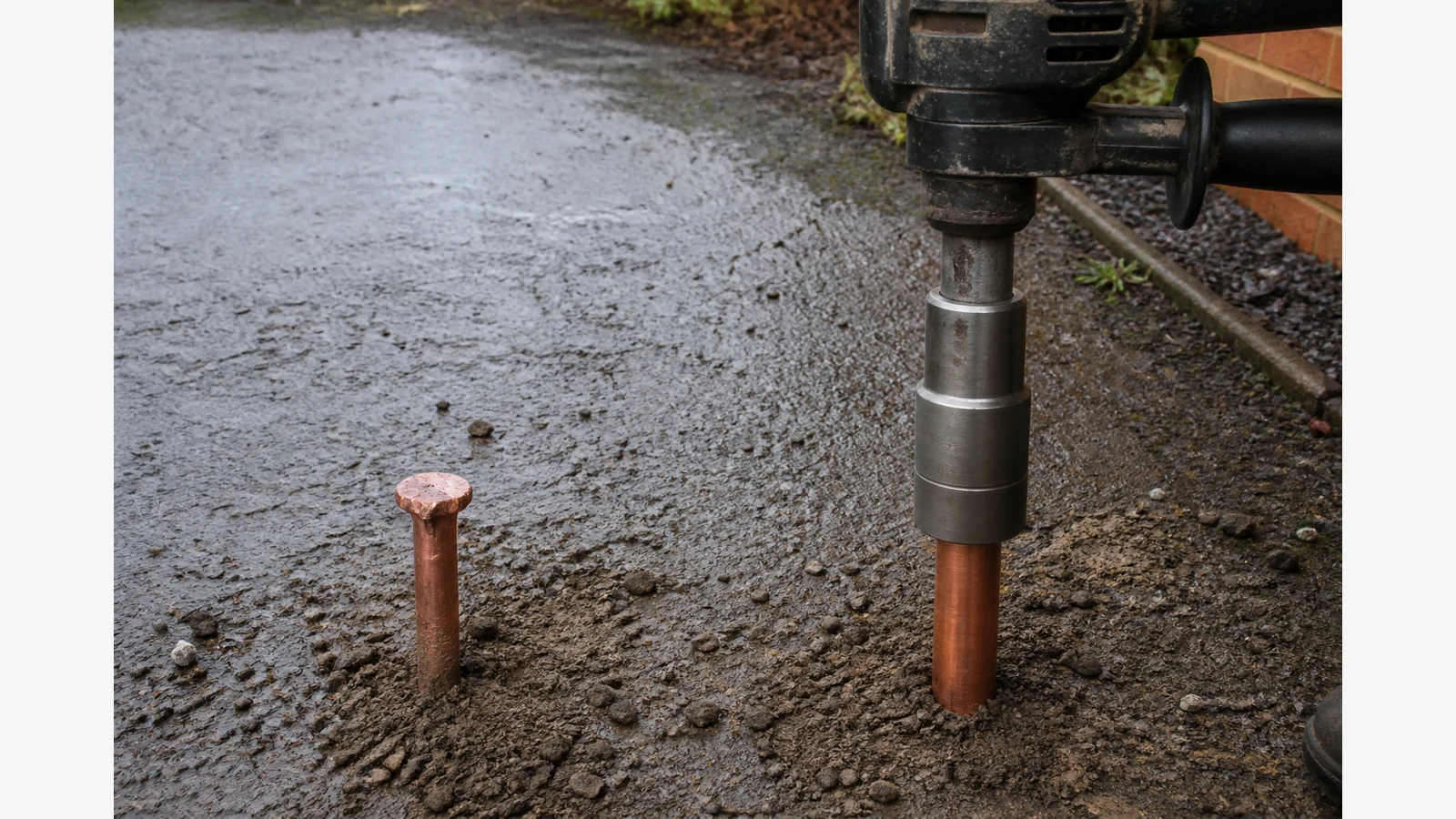
An impact socket can push a copperbond earth rod into soft ground, but it leaves the rod top unsupported. Off-centre hits and bare-end hammering are what flare the tip into a mushroom and ruin clamp seating. A proper earth-rod driver — typically an SDS Max seat or a matched driving stud — centres the force and protects the tip for UK trade installs.
Why vans still reach for an impact socket
Impact sockets are already in the kit, they fit the drill, and on soft clay they “work” until the top mushrooms. That improvisation is fine for a temporary tent stake; it is a poor habit for chargepoint, TT or lightning-protection electrodes where the top must stay round for clamps and couplings.
What UK trade kits actually use
UK merchants sell dedicated SDS Max earth rod drivers for driving rods into soil, including lightning-conductor work. Earthing accessory makers also list SDS Max drivers sized for common 5/8 and 3/4 copperbond rods. Separately, copper driving heads and studs are sold to absorb hammering force and stop rod-end deformation while you drive.
Those two ideas — a reusable powered seat and a sacrificial or reusable driving stud — are complementary, not competitors. The stud protects threads on threaded copperbond systems; the driver seat keeps the hammer square on the protected top.
Decision table: socket versus proper driver
| Factor | Impact socket on bare rod | Dedicated SDS Max / seat driver |
|---|---|---|
| Rod-top seating | Loose; easy to hit off-centre | Designed opening seats the tip |
| Mushrooming risk | High on hard ground | Lower when used with a matched stud/head |
| Mixed 1/2·5/8·3/4 stock | Needs multiple sockets | Multi-opening seats can cover mixed vans |
| Sledge fallback | Still unprotected | Stud/head still protects if you switch to sledge |
| When improvising is still wrong | Threaded copperbond for electrode work | Never skip service scans or design depth |
Who should not upgrade yet
Occasional DIY tent-anchor or temporary fence posts do not need a trade earth-rod driver. Upgrade when you regularly drive copperbond for EV chargepoint electrodes, lightning grids or TT electrodes and you are tired of dressing mushroomed tops before the clamp goes on.
Reader next step
Size-check the rod diameters in your van (commonly 1/2, 5/8 and 3/4 nominal) and confirm you own an SDS Max rotary hammer rather than SDS Plus. If you carry mixed stock and want one reusable seat, see our notes on a mixed-size earth rod driver for UK vans and the product page for the Universal Ground Rod Driver. For the mushrooming failure mode itself, read how to stop earth rod mushrooming.
FAQ
Does a proper driver require SDS Max?
Most UK trade powered drivers are SDS Max shanks for heavy rotary hammers. Confirm your chuck before buying; SDS Plus tools are a different interface.
Is a driving stud the same as a driver seat?
No. A driving stud or head protects the rod tip/threads; a seat-style driver couples that protected top to the hammer. Many installs use both.
What should I inspect after driving?
Check the top for flare, confirm enough clean length for the clamp, and keep inspection-pit access clear. A full field sequence is in the UK earth-rod installation checklist.